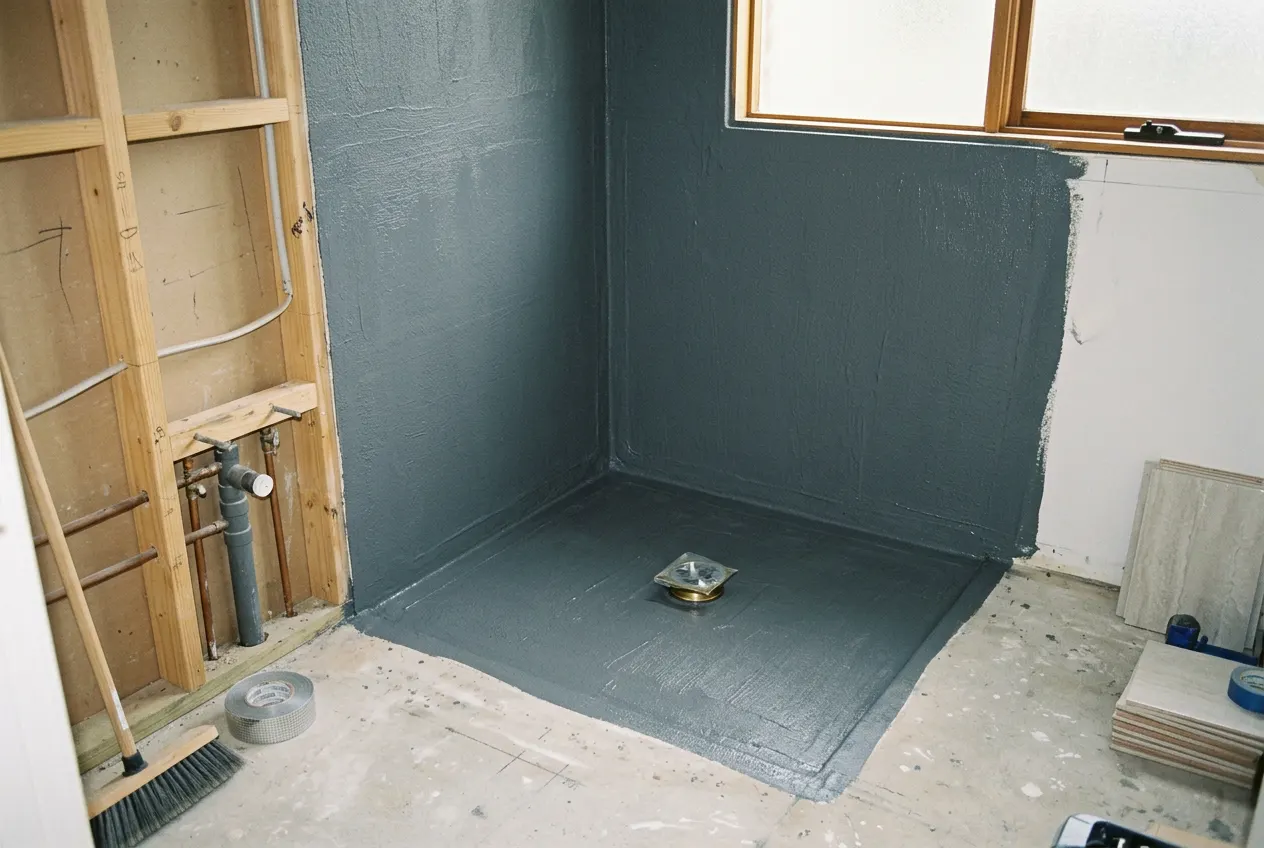
In NSW, residential waterproofing work worth more than $5,000 in labour and materials, including GST, must be done by a contractor holding the appropriate licence. The membrane has to follow the current Australian Standard, AS 3740:2021, and the building code requirements for each surface in the room. In work that needs approval it must also be inspected before it is covered. This post sets out who may do the work, what the standard and the code cover, and what to ask for before a single tile goes down.
What a bathroom renovation costs is on bathroom renovation cost in 2026, so we leave prices out here. Our bathroom renovations page covers how we run the job.
Who may waterproof a bathroom
NSW treats waterproofing as a recognised trade, covering membranes applied by brush, roller or other methods. For residential work worth more than $5,000 including GST, the contractor must hold the appropriate licence, and NSW sets penalties for unlicensed work under the Home Building Act 1989. The rule also reaches subcontracted work that forms part of a contract over the threshold, so a small waterproofing line in a big job does not escape it.
What to check depends on who you are contracting with:
| Who you are hiring | What to check |
|---|---|
| A waterproofing contractor | A current contractor licence that covers waterproofing |
| A licensed general builder running the renovation | The licence covers general building work with no relevant restriction. NSW lists waterproofing as general trade work for a general builder |
| A kitchen, bathroom and laundry renovation contractor | The exact licence category and conditions. That category covers renovation work but excludes load-bearing parts that the building's stability depends on |
| Whoever supervises the work | A supervisor certificate and a contractor licence do different jobs. Check both the business contracting with you and the person supervising |
The business that signs the contract, the person who supervises the work and the worker who applies the membrane are three different roles. Not every worker needs their own contractor licence, and a supervisor certificate alone does not authorise a business to contract with you.
Owner-builders are a separate case. NSW generally requires an owner-builder permit for relevant work over $10,000 where a licensed builder is not supervising. A permit is not a building licence. Our owner-builder vs licensed builder post covers that decision.
Approval comes before demolition
A bathroom renovation does not automatically need council approval, but not every one is exempt either. The NSW Planning Portal says minor renovations can be exempt development only where they meet every relevant standard in the Codes SEPP (Exempt and Complying Development Codes 2008), and exempt work still has to be structurally adequate. Some internal alterations can use complying development, and work outside those limits needs a development application. The Portal also lists restrictions for State Heritage Register items, interim heritage orders, wilderness areas and critical habitat. Our CDC vs DA post explains the pathways.
In an apartment, planning and strata are separate gates. NSW strata guidance classes changes that involve waterproofing, with bathroom renovations as the example, as major renovations. Only the owners corporation can approve them, by special resolution at a general meeting. Get that approval before you disturb the existing waterproofing or any common property.
What the standard and the building code cover
AS 3740:2021, Waterproofing of domestic wet areas, is listed by Standards Australia as current. AS 3740:2010 is superseded. The standard sits alongside the National Construction Code and the project's approval. NSW and the ABCB publish 1 May 2027 as NSW's adoption date for NCC 2025, so a renovation built before then is not governed by NCC 2025 just because that edition has a web page. Ask the builder to name the edition and the compliance route in writing. "AS 3740 compliant" on a quote does not say which.
These are selected requirements from Part 10.2 of the NCC 2022 Housing Provisions. They are not a full design specification and they do not replace the provisions for apartment buildings.
| Location | Selected requirement |
|---|---|
| Shower floor, including a hob or step-down | Waterproof |
| Shower walls | Waterproofed to at least 1,800 mm above the floor substrate |
| Shower wall junctions, joints and penetrations | Waterproofing at least 40 mm either side of joints. Wall and floor junctions and penetrations are also waterproofed |
| Floor outside the shower: concrete, compressed fibre-cement, fibre-cement sheet | Water resistant |
| Floor outside the shower: timber, particleboard, plywood and other timber-based | Waterproof |
| Basin, sink or laundry tub within 75 mm of a wall | The wall must be water resistant to at least 150 mm above the vessel |
| Floor with a floor waste | Continuous falls between 1:80 and 1:50 |
The surfaces are treated differently, so the same membrane layout does not suit every bathroom. A whole-floor membrane may be needed because of the substrate, the shower layout or the chosen design, and a timber floor cannot be treated like a concrete slab. Ask for a wet-area layout that shows the substrate, the extent of the membrane, the shower enclosure, junctions, penetrations and drainage, and treat "waterproof" and "water resistant" as different words.
Curing times belong to the product
There is no single drying time. Recoating, tiling, flood testing and exposure to service water each have their own waiting period for a given product. As one example, ARDEX's WPM 002 datasheet gives these times at 23 degrees C and 50% relative humidity:
| Step | Datasheet timing |
|---|---|
| Between coats | 1 to 2 hours |
| Tiling or screeding | 24 hours after the final coat |
| Flood testing | 48 hours after the final coat, subject to final inspection |
| Full cure for immersed areas, including showers | 72 hours after the final coat |
Those figures belong to that product under those conditions. They are not an AS 3740 timetable. ARDEX's flood-testing bulletin says cooler or more humid conditions lengthen curing, and it requires a check for voids and pinholes before testing. After a successful flood test the installer drains and dries the area and leaves the membrane at least 24 hours before tiling. The 24 hours before tiling on the datasheet therefore does not remove the flood-testing steps. The datasheet also specifies two coats with a dry film thickness of 1.2 mm on floors and 0.8 mm on walls, which are values for that product.
Ask for the current datasheet for the product being used and a written programme that records application times, conditions and release points. A surface that looks dry does not show that the cure time or thickness has been met. How this fits the schedule of the whole job is in how long a renovation takes.
What to ask for before tiling
The installer signs the compliance declaration. The owner does not certify the membrane. What you can do is check and keep records:
- Product and scope. Photograph the labelled containers and the treated areas before they are covered. The signed declaration should name the system, where it was applied and the requirements it was applied to.
- Corners, penetrations and waterstops. Look for visible gaps or damage and compare with the agreed details. Appearance does not prove compliance.
- Coats and thickness. Ask to see the application and thickness records, and note the dates.
- Curing and testing. Compare what actually happened with the product's current datasheet.
- Inspection before covering. For approved Class 1a work, the NSW certifier practice standard lists inspection before waterproofing in wet areas is covered as a critical stage. A contractor's certificate does not replace it. For exempt work with no certification process, make a signed installer compliance statement and pre-cover records part of the contract.
- Handover. Keep the signed certificate, product documents, photographs and any inspection records.
Not every document called a certificate of compliance is the same thing. NSW certifier guidance separates supporting documents from an EP&A Act compliance certificate, and says documents do not replace the mandatory critical-stage inspections. As an example of the content, Wagga Wagga City Council's waterproofing certificate records the site, the treated areas, the product, the contractor and licence details, and declarations about the compliance route, the materials and manufacturer's specifications.
Do not tile over unresolved defects, missing inspection access or unclear paperwork. In older homes, hidden damage often shows up once the old lining comes off, which is covered in damp and mould in older Illawarra homes.
Warranty and insurance are different things
NSW statutory warranties apply even if the contract leaves them out. They generally run for 6 years for major defects and 2 years for other defects, from completion. Waterproofing is a major element, but a waterproofing defect is a major defect only if it also meets the legal test in section 18E of the Home Building Act, which includes serious consequences such as being unable to use the building for its purpose. So a builder who calls every leak minor is wrong to do so, and so is a contractor who says every membrane fault carries six years. If the classification or the deadline is disputed, get advice early, and do not assume that negotiating repairs stops the clock for starting proceedings.
Home Building Compensation Fund insurance is generally required for covered residential work over $20,000 including GST. It is last-resort cover, for example where the contractor becomes insolvent, dies, disappears or has their licence suspended for failing to comply with a money order. The contractor must obtain it and give you the certificate before asking for a deposit or other contract payment. The insurance certificate and the waterproofing certificate are separate: one is financial protection and the other records the installation.
Where we come in
We run bathroom renovations as one licensed team, from strip-out to waterproofing and tiling, on a fixed-price proposal. To have us look at a bathroom, send the address and a few photos through the contact page, or call 0434 037 851. A leaking shower in a house we have never seen is not something to diagnose from a photograph, and we will say so. For ideas on layout, see small bathroom renovation ideas.
Sources
- Waterproofing work, General building work and Categories of work, NSW Government
- Exempt development, NSW Planning Portal
- AS 3740:2021, Standards Australia
- NSW to adopt new National Construction Code in May 2027, NSW Government
- ARDEX WPM 002 datasheet and flood testing bulletin TB266, ARDEX Australia
- Certifier practice advice FAQ and Contracts, NSW Government
- Home Building Act 1989 s 18E, AustLII
- Waterproofing compliance certificate, Wagga Wagga City Council
Common questions
Can you legally waterproof your own bathroom in NSW?
NSW requires the appropriate contractor licence for residential building or trade work worth more than $5,000 in labour and materials, including GST. That includes waterproofing, and the threshold also applies to subcontracted work that forms part of a larger contract. Below $5,000 the licence rule does not apply, but that is a licensing threshold and not advice to do it yourself. An owner-builder permit is separate: it is generally needed for work over $10,000 and is not a building licence.
What are the Australian standards for bathroom waterproofing?
AS 3740:2021, Waterproofing of domestic wet areas, is the current standard, and AS 3740:2010 is superseded. It sits alongside the National Construction Code (NCC) and the NSW requirements for the project. NSW has published 1 May 2027 as its adoption date for NCC 2025, so ask your builder which edition and compliance route the job is being built to.
Does the entire bathroom need to be waterproofed?
Not in the same way everywhere. Under the NCC 2022 Housing Provisions the shower floor must be waterproof and the shower walls waterproofed to at least 1,800 mm above the floor. Outside the shower, concrete and fibre-cement floors must be water resistant, while timber-based floors must be waterproof. Treat 'waterproof' and 'water resistant' as different requirements, and ask for a layout showing the membrane extent.
How many years does bathroom waterproofing last?
We have no source that gives a service life for a membrane, so we do not quote one. What is documented is the legal protection: NSW statutory warranties generally run 6 years for major defects and 2 years for other defects from completion. Not every leak is a major defect, so a leak does not automatically carry the six years.
What happens if waterproofing is not done?
If a membrane is missing or badly done, water can get into the wall and floor framing, and the damage is often found only after it has spread. The legal position is that licensed work must meet the standard, the builder owes due care and skill, and in approval work the membrane must be inspected before it is covered. Photograph and report a leak in writing promptly, because warranty claims have deadlines.
What is the average cost to waterproof a shower?
We do not quote waterproofing as a separate figure because it depends on the room, the substrate and the scope. Our bathroom renovation cost page sets out what we budget for a whole bathroom, and waterproofing is part of that price.
Do I need council approval to renovate a bathroom in NSW?
Not always. The NSW Planning Portal says minor renovations can be exempt development, but only where every relevant standard is met, and exempt work must still be structurally adequate. Some internal alterations can go through complying development, and others need a development application. Heritage restrictions apply, and in an apartment the owners corporation must approve a bathroom renovation involving waterproofing as a major renovation. Settle the pathway before demolition.
Want a hand with this at your place? Get a free quote or call 0434 037 851.