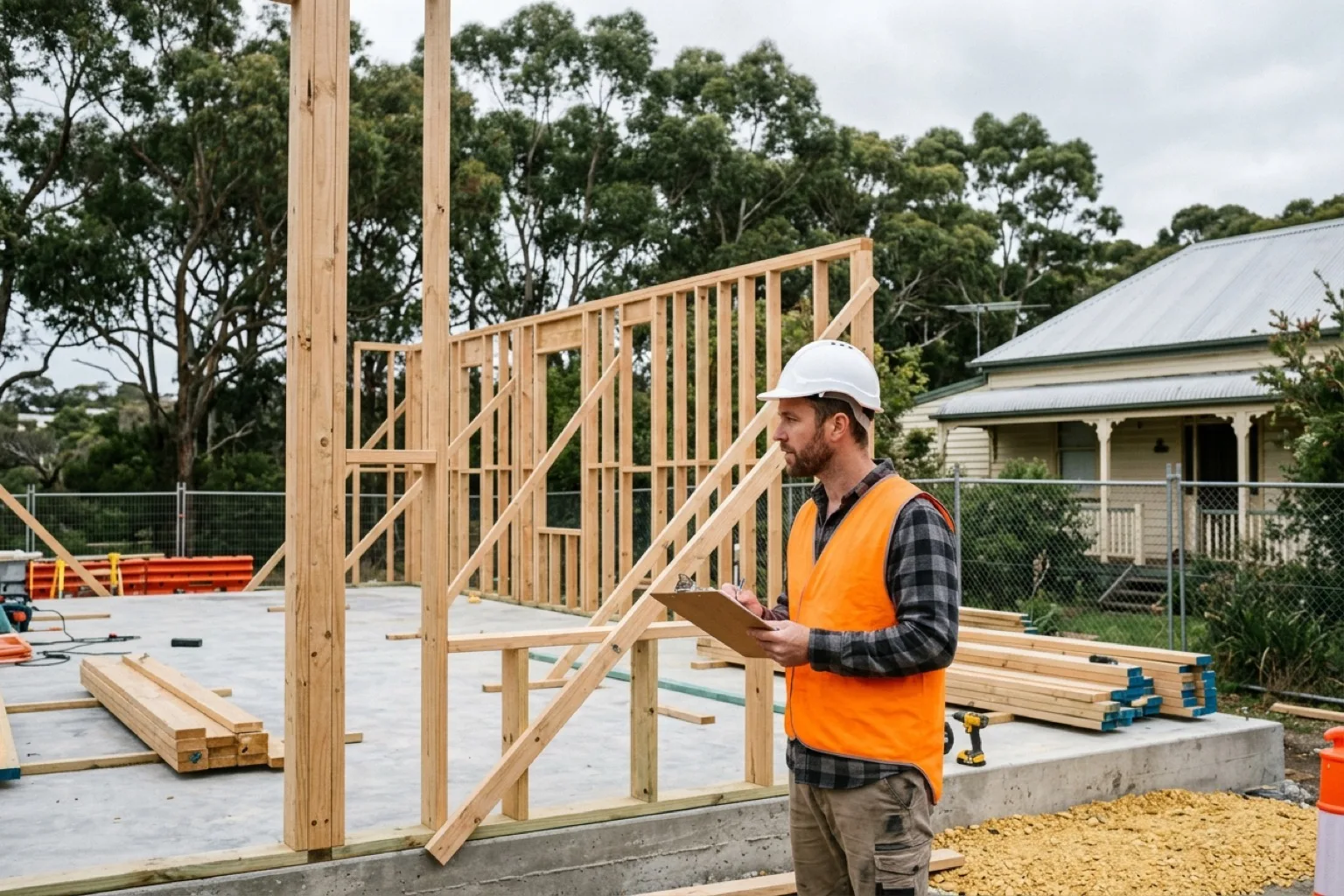
A fellow at Dapto rang me about eight months into his owner-build. He'd done the course, had the permit, had the white card, and had a spreadsheet that said he'd save roughly a fifth of what a builder would charge for a four-bedroom house on a flat block. The slab was down. The frame was half up. And the frame carpenter had walked off to a job that paid him on time, the window order was wrong because nobody had checked the schedule against the final frame, and the certifier had turned up for the frame inspection, found no bracing plan on site, and gone away again.
He wanted me to take it over at frame stage. We did, eventually, and the house is fine. But by the time we'd unpicked what had been done, priced what hadn't, and reordered the windows, the saving on his spreadsheet had gone, and then some. That job is the reason I have an opinion on this question, and it's not the opinion people expect from a builder, because I think owner-building is a perfectly good idea for about one person in twenty who asks me about it.
This piece is about the other nineteen. Not to talk you out of it. To make sure the spreadsheet has the right rows in it.
What the permit is, and what it isn't
In NSW, if you want to do or supervise building work worth more than $10,000 on your own home and you're not engaging a licensed builder to supervise it, you need an owner-builder permit. Above $20,000 you also have to complete the approved owner-builder education units before the permit is issued. You need a white card, you need to own the land or hold a long lease on it, and you need to intend to live in the house afterwards. Only one permit can be issued to a person in any five-year period unless it's for the same land. The NSW Government sets all of that out on its page on when an owner-builder permit is needed.
What people miss is the sentence on that same page that matters most. As an owner-builder you are responsible for the building work as a fully licensed builder would be. The permit isn't a discount licence. It's the state saying that for this one house, you are the builder, with everything that comes with it, and none of the training, the trade relationships or the insurance that a licensed builder brings to the same job.
That's the deal. Everything below is just what the deal costs.
The insurance you don't get
When you engage a licensed builder for a job over $20,000, the builder has to take out home building compensation cover before taking a deposit, and you get a certificate. That cover is there if the builder dies, disappears or goes insolvent with your money and half a house. It's the reason people are told to see the certificate before paying anything.
As an owner-builder, there's no builder to insure. Your own work isn't covered. Each contractor you engage directly for more than $20,000 has to give you their own certificate of cover for their slice of the work, and you should have it in hand before they start and before you pay anything. But the gaps between those slices, the coordination, the parts you did yourself, the parts done by the mate who was going to do the tiling at cost and then didn't, none of that is insured by anyone.
The other half of this is what happens when you sell. If you sell within seven years and six months of the permit being issued, the contract for sale has to carry a consumer warning saying an owner-builder permit was issued for the land, and the buyer can void the contract before settlement if it's missing. More to the point, the next owner gets the benefit of the statutory warranties on your work, and they can take you to the tribunal to enforce them. The Government's page on working as an owner-builder puts it in capital letters. You are guaranteeing the work. Not the tiler. You.
I've seen that play out. A couple sold an owner-built house at Oak Flats about four years after finishing it. The buyer's building inspector found a shower that hadn't been waterproofed to the standard, and it became the seller's problem, at the seller's cost, with a tribunal date attached. A licensed builder carries that risk as part of the job. An owner-builder carries it personally, on a house they no longer own.
Where the saving is, and where it evaporates
The saving is real, on paper. A builder's price on a new house carries a margin for running the job and a margin for the risk of running it. Take the builder out and, in theory, you keep both.
In practice, the first margin gets spent on you. Somebody still has to do everything the builder does. Sequence twenty trades so none of them are waiting on another. Order materials against a program so the frame timber arrives the week the slab has cured and not three weeks earlier, sitting in the weather. Read the engineer's drawings closely enough to know the bracing plan needs to be on site for the frame inspection. Answer the phone at seven in the morning when the plumber wants to know where the sewer junction is. On a full house that's a job, and if you're doing it around another job the build simply runs at the speed of your spare time. I've written elsewhere about how long a house takes to build with a builder running it full time. Add a good chunk to every stage for a part-time owner-builder, and then add the holding cost of the block and the rent for those extra months.
The second margin, the risk one, doesn't disappear either. It just moves from the builder's ledger to yours. That's the Dapto window order. That's the concrete pump booked for a day the formwork wasn't ready. That's the extra soil test because the first one was ordered for the wrong corner of the block. Builders make those mistakes too, and when we do, we wear them. When an owner-builder makes them, the house wears them.
Then there's buying power. My trades give me a price because I bring them the next job, and the one after. My supplier gives me a rate because of the volume across a year. An owner-builder ordering once gets the retail price and the retail lead time. On a modest house that difference alone eats a fair slice of the theoretical saving before anyone has made a mistake.
What the certifier sees
The part I'd most want a first-time owner-builder to understand is the certifier. On a new house in NSW the principal certifier has to do a set of critical stage inspections, and they can't issue the occupation certificate at the end unless those were done and passed. The certifier works for the approval, not for you. If the frame doesn't match the engineer's drawings, they'll tell you, in writing, and the frame doesn't get signed off until it does.
A builder has a working relationship with that process. We know which inspections need what on site, we know that the certifier wants to see the waterproofing before the tiles go on and the bracing before the linings, and we book the inspections around the trades so nothing has to be pulled apart to be looked at. An owner-builder learns that as they go, and the tuition is paid in weeks. The Dapto frame inspection cost about three of them, because by the time the bracing plan was sorted the carpenter had moved on.
Council is the same story. Conditions of consent that a builder reads on day one and builds the program around, an owner-builder tends to discover one at a time, usually when the certifier asks for the thing the condition required.
Who it actually suits
Here's my honest list. Owner-building tends to work when the person is a tradesperson themselves, or has run building sites for a living, or is building something small and simple, a shed, a modest granny flat, a deck, where the trade count is low and the sequence is short. I've talked people through the supply-only granny flat kit question in the same terms, because a kit with an owner-builder permit behind it is the same bet at a smaller scale. And it works when the person has time. Not evenings and weekends. Time.
It tends not to work for a full house, for a first build, for someone with a job and a young family, and for anyone whose plan for the hard bits is "I'll find a bloke." Finding the bloke is the job.
There's a middle path that's underrated. Engage a builder for the shell, slab to lock-up, under a proper contract with the insurance that comes with it, and then take on the fit-out yourself under a permit if you've got the skills. That gets the structure done by people who do it every week, gets the certifier's critical inspections passed without drama, and leaves the parts where an owner's own labour genuinely saves money, painting, landscaping, some of the finishing, in the owner's hands. It's not as tidy as the spreadsheet, but I've watched it end well more often than the full owner-build has.
If you're still deciding
Price both properly. Get a builder's fixed price for the whole house, and have a look at what a house costs to build in NSW so you know what you're comparing against. Then build your own estimate the way a builder would, line by line, with retail prices, lead times, the holding costs for the extra months, an allowance for the mistakes you'll make once each, and an honest number for your own hours. If the gap is still big enough to be worth carrying the risk personally for seven and a half years, and you've got the time, go for it. Plenty of good houses in the Illawarra were owner-built.
If the gap closes, and it usually does, then the question becomes which builder, and that's the one I wrote how to choose a home builder in NSW for. We build custom homes across the Illawarra on a fixed-price contract, and I'm happy to price your plans against your spreadsheet. Call 0434 037 851 or send the drawings through the contact page.
Want a hand with this at your place? Get a free quote or call 0434 037 851.